Soap packaging loses sales when it creates doubt about quality, hides information or lets the bar arrive damaged. The most expensive mistakes usually begin before artwork is printed: an inaccurate fit, the wrong board, weak moisture planning or no room for required product details.
A well-fitted soap box protects the bar and gives customers a clearer reason to trust the product.
Why does soap packaging affect sales?
Soap packaging shapes the buyer’s judgement before the bar is handled or used. A box that feels firm, reads clearly and matches the product suggests care; crushed corners, vague claims and an oversized cavity suggest the opposite. For online orders, the pack also has to survive fulfilment and still look presentable when photographed or unboxed.
The aim is not to add more decoration. Effective soap packaging performs four jobs at once: it contains the bar, protects its surface, communicates product information and makes the brand recognisable. A decision that improves only one job can weaken another. A large window, for example, may improve visibility but reduce panel strength or leave too little room for ingredients.
1. Guessing the box size instead of measuring the finished soap
An inaccurate fit makes a soap bar slide, rub or look smaller than expected. It can also force the carton to bow if the bar varies slightly between batches. Measure the fully cured, wrapped product rather than relying on the mould dimensions. Record length, width and depth at the widest points across several samples.
Add only the clearance needed for loading and natural product variation. The correct allowance depends on the wrap, board and packing method, so test a blank sample before confirming the cutting die. A paper-wrapped bar needs different clearance from a bare bar with textured edges.
Practical fix: measure at least five finished bars from different batches, use the largest realistic dimensions and approve a plain structural sample before printing.
2. Ignoring moisture, fragrance oils and the curing stage
Paperboard can mark, soften or absorb oils when soap is packed too early or placed directly against an unsuitable stock. The risk varies with the formulation, curing time, humidity, surface oils and whether the bar has an inner wrap. A board described as premium is not automatically compatible with every soap recipe.
Let the product reach its intended packing condition before testing it. Where direct contact is planned, confirm material suitability with the packaging supplier and the relevant product-safety adviser. A glassine-style wrap, grease-resistant inner layer or suitable coating may help, but each option changes recyclability, appearance and cost.
Practical fix: place production-ready samples in the proposed pack for a realistic storage period, then inspect the board for oil transfer, staining, odour change and loss of stiffness.
3. Choosing a packaging format because it looks fashionable
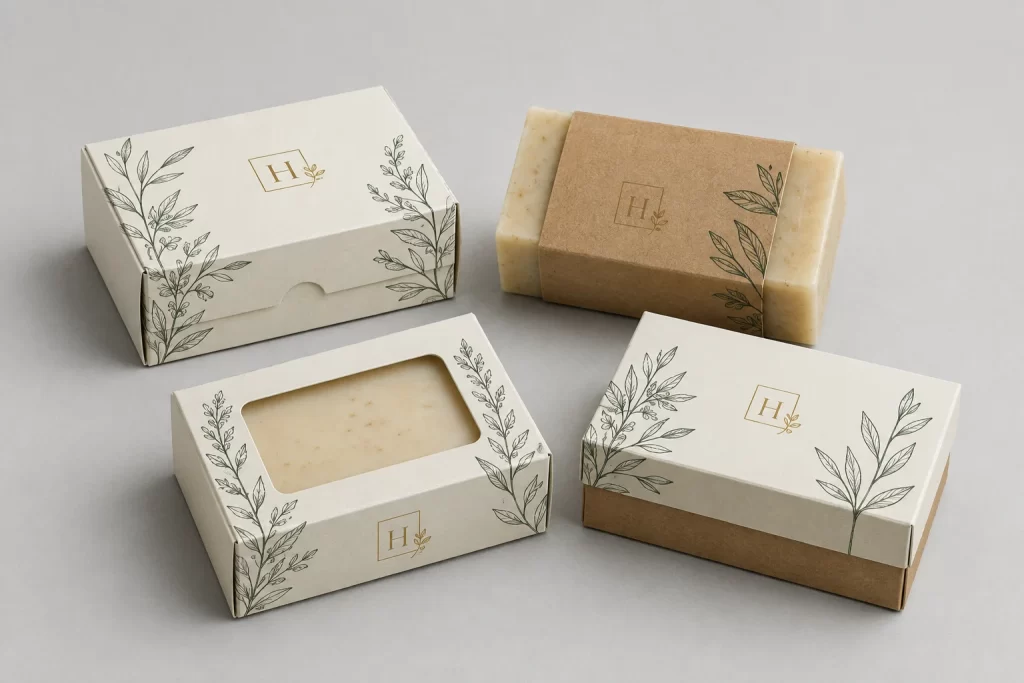
The right soap packaging format depends on the sales channel, protection level, labelling space and price position. A sleeve suits a bar that can remain partly exposed, while a folding carton provides more protection and printable area. A window box displays colour and texture, but its opening and film choice need careful planning.
Common soap packaging formats serve different retail, protection and presentation needs.
| Format | Best suited to | Main strength | Watch for |
| Paper sleeve | Small runs, artisan bars and simple retail presentation | Low material use and visible product | Less edge and surface protection |
| Folding carton | Retail shelves, subscriptions and e-commerce | Good protection with useful print area | Fit and closure must be tested |
| Window carton | Decorative, textured or coloured soaps | Shows the product before purchase | Panel strength, window material and label space |
| Two-piece or rigid box | Gift sets and premium collections | Strong presentation and keepsake value | Higher cost and greater material use |
Brands comparing these formats can browse Hi Custom Boxes’ custom soap packaging range to see product-specific structures rather than forcing one box style onto every bar.
4. Selecting board by appearance alone
A board can look attractive as a flat sample but fail after creasing, stacking or courier handling. Grain direction, thickness, stiffness, surface finish and the size of any cut-out all affect performance. An unnecessarily heavy board can also raise cost and material use without improving the customer experience.
Kraft board fits natural positioning and hides minor scuffs well. White paperboard gives a cleaner base for colour printing. Textured or rigid stocks can support premium lines. The correct choice is the lightest practical construction that protects the product and produces the intended finish.
Practical fix: request a sample made in the proposed dimensions and board, then test creases, tabs, stacked cartons and printed colour before approving the run.
5. Treating product information as leftover artwork
Product information needs planned panel space and a readable hierarchy. In Great Britain, cosmetic product packaging generally needs information such as the product function, precautions, nominal weight or volume where applicable, Responsible Person details, a batch identifier, durability information, country of origin for imports and an ingredients list. The information must be in English and easy to read.
The exact requirements depend on the product and how it is supplied. Check current guidance and obtain competent regulatory advice before printing. The UK Government’s cosmetics product guidance is a useful starting point; packaging artwork is not a substitute for a safety assessment or compliance review.
Practical fix: reserve a clear information panel at the dieline stage. Do not shrink mandatory copy at the end to make room for marketing text.
6. Printing vague or unsupported product claims
Claims such as “natural”, “plastic-free”, “organic”, “hypoallergenic” or “zero waste” can influence a purchase, but each claim needs to be accurate and supportable. UK guidance states that cosmetic labels and advertising must not imply characteristics or functions the product does not have.
Environmental wording should describe the actual pack rather than rely on broad green language. Name the material, say which part is recyclable and give disposal instructions that match the UK waste stream where possible. If a window or coating changes disposal, the wording should reflect that.
Practical fix: keep a claim-evidence sheet for every statement printed on the pack and have product and environmental claims checked before artwork approval.
7. Designing for a monitor instead of the printed carton
Bright RGB artwork, very fine lines and small reversed text can look good on screen and fail on an absorbent or textured board. Creases, glue areas, tabs and windows also interrupt a design once the flat dieline becomes a three-dimensional pack.
Build artwork on the approved dieline with bleed, safe zones and the correct colour setup. Use vector logos where possible. Check barcode size and contrast, keep important copy away from folds, and obtain a printed proof when colour accuracy matters.
Practical fix: inspect both the flat proof and a 3D or physical sample. Rotate the assembled box through every customer-facing angle, including the base and opening flap.
8. Adding layers or openings that frustrate the buyer
Soap packaging should open without tearing the product label, spilling an insert or requiring unnecessary force. Extra wraps, tight tabs and decorative bands may create friction without adding useful protection. The same problem affects fulfilment teams when a carton is slow to assemble or difficult to load.
Observe someone unfamiliar with the pack opening and closing it. If they hesitate, damage the box or turn it repeatedly to find the opening, revise the structure. Accessibility and packing speed are product costs, even when they do not appear on the print quotation.
Practical fix: time the packing process and run an unboxing test with people who were not involved in the design.
9. Approving a full print run without physical testing
A digital mock-up confirms layout, not real-world performance. It cannot prove that a tab holds, a window remains secure, ink resists rubbing or the bar will arrive without surface damage. Testing is especially useful when launching a new size, changing suppliers or moving from retail-only sales to postal fulfilment.
Test representative packed units through stacking, handling and a trial shipment. Inspect corner crushing, movement inside the box, ink scuffing, closure security, odour transfer and legibility after delivery. Record the results so the next order improves rather than starting from memory.
Practical fix: approve structure, artwork and packed-product performance as three separate checks before authorising production.
What should a soap brand check before printing packaging?
- The dimensions come from fully cured, production-ready soap bars.
- The proposed material has been tested against the actual formulation and wrap.
- The structure matches the sales channel and required protection.
- Required product information has its own readable panel space.
- Every product and environmental claim can be supported.
- Artwork uses the approved dieline, bleed and print colour setup.
- Barcodes, small text, folds, tabs and windows have been checked on a physical proof.
- A packed sample has passed handling, stacking and delivery tests.
- Disposal instructions describe the real materials used.
- The final approved artwork has a version number and sign-off record.
How can better soap packaging support repeat sales?
Better soap packaging reduces uncertainty. The buyer can identify the product, read the relevant information and receive the bar in the condition expected. Consistent colour, structure and naming across a range also make the next fragrance or formulation easier to recognise.
Start with fit and function, then use print and finishing to express the brand. Hi Custom Boxes produces made-to-measure packaging for UK brands, with options for folding cartons, sleeves, windows, kraft stocks and premium presentation boxes.
Editorial note: Packaging and cosmetic rules can change. This article provides general packaging information, not legal or product-safety advice. Confirm the current requirements for your formulation, market and sales method before production.
Need packaging advice for your next order?
Share your box size, material, quantity, and artwork needs. Our team can guide you before production starts.