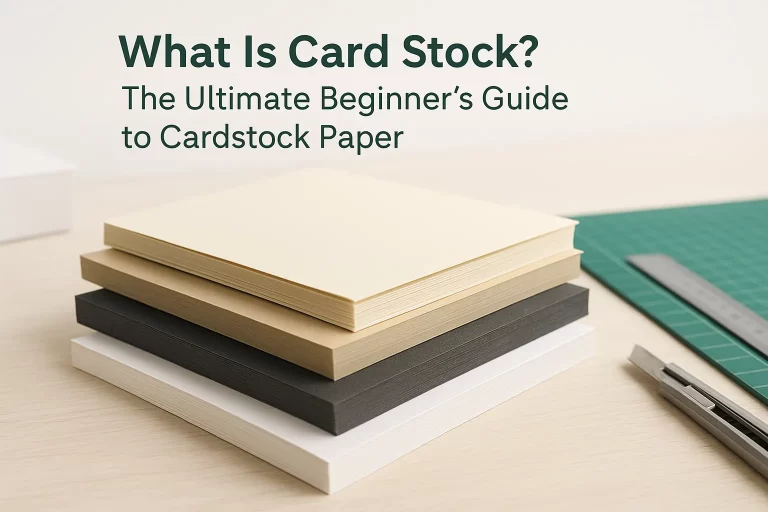
Cardboard is not one single
packaging material. In trade use, the term can refer to folding boxboard for
printed retail cartons, corrugated board for transit packaging, kraft-based
board for a natural finish, or greyboard used inside rigid presentation boxes.
The right choice depends on product weight, fragility, box dimensions, print
finish, storage conditions and how the pack will travel.
Choosing too little board can lead
to crushed corners, split seams and damaged products. Choosing too much adds
cost, weight and material without improving the customer experience. This guide
explains how the main cardboard materials differ and what UK businesses should
check before ordering.
What Is Cardboard Material in Practical Packaging Terms?
Cardboard is a broad, informal name
for several paper-based boards used to make boxes and packaging. Packaging
suppliers normally specify the actual material, such as folding boxboard, solid
bleached board, kraft board, corrugated board or greyboard, because each
behaves differently during printing, cutting, folding, storage and transport.
A skincare carton may use smooth
folding boxboard because print quality matters. An ecommerce shipper usually
needs corrugated board because the fluted centre adds rigidity and cushioning.
A premium gift box may use dense greyboard wrapped with printed paper because
presentation and shape retention matter more than flat-pack convenience.
What Are the Main Types of Cardboard Used for Packaging?
The four broad groups most buyers
encounter are paperboard, corrugated board, kraft board and greyboard. These
names describe different constructions rather than interchangeable grades.
Corrugated Cardboard
Corrugated cardboard combines one or
more fluted paper layers with flat liner sheets. The arches in the flute help
the board resist impact, bending and compression, making corrugated board the
usual choice for shipping boxes, ecommerce mailers, product trays and larger
retail packs.
Common constructions include:
- single-face board: one liner bonded to one exposed flute;
- single-wall board: one flute between two liners;
- double-wall board: two flutes with three liners; and
- triple-wall board: three flutes with four liners for demanding transit applications.
More walls do not automatically mean
a better box. A compact, lightweight product may be adequately protected by a
well-designed single-wall pack, while a heavy or fragile item may require
double-wall board, internal fittings or both.
Paperboard or Folding Carton Board
Paperboard is a smooth, relatively
thin material used for folding cartons. It can be printed, creased, die-cut,
laminated and supplied flat before assembly. Typical applications include
cosmetics, confectionery, pharmaceuticals, candles, small electronics and other
lightweight retail products.
Paperboard is usually the better
option when fine graphics, accurate colour and a clean shelf appearance matter
more than transit strength. Different fibre compositions and coatings affect
whiteness, stiffness, print response and suitability for the packed product, so
GSM alone should not decide the specification.
Kraft Board
Kraft board is made with
kraft-process fibres and is recognised for its strength and natural brown
appearance, although white-top and coated kraft grades are also available. It
is used for folding cartons, corrugated liners, mailers, sleeves and
food-related packaging where the correct grade and barrier are specified.
Natural kraft can support a less
processed visual style, but a brown colour does not by itself prove that a pack
is recycled, recyclable or suitable for direct food contact. Fibre source,
coatings, laminations, inks and local collection systems all affect the
environmental claim.
Rigid Board or Greyboard
Greyboard is a dense board commonly
used as the structural core of rigid boxes. The board is normally cut rather
than folded along conventional carton creases, then wrapped with printed or
decorative paper. This construction produces a firm box with strong
presentation value.
Rigid board suits gift sets,
jewellery, cosmetics, electronics and presentation packs. It costs more to
manufacture and transport than a flat folding carton, but it offers better
shape retention and a more substantial opening experience.
Which Cardboard Is Best for Each Type of Packaging?
| Packaging requirement | Suitable starting point | Main reason | Check before ordering |
|---|---|---|---|
| Lightweight printed retail carton | Folding boxboard or suitable paperboard | Smooth print surface and efficient folding | Product weight, crease direction and finish |
| Ecommerce mailer | E-flute or B-flute corrugated board | Protection with practical assembly | Product movement, courier handling and box size |
| Standard shipping carton | B-flute or C-flute single-wall corrugated board | Stack and transit performance | Board grade and verified box strength |
| Heavy or fragile shipment | Double-wall corrugated board with fittings where needed | Higher rigidity and cushioning | Packed-weight tests and stacking conditions |
| Natural-looking retail pack | Kraft-based folding carton or kraft-lined corrugated board | Strong fibres and an unbleached appearance | Print contrast, rub resistance and coating |
| Premium presentation box | Wrapped greyboard | Firm construction and luxury feel | Insert, wrap paper, closure and transport protection |
This
table is a starting point, not a production specification. The final board
should be tested using the actual box dimensions, packed product, route to
market and storage environment.
What Do Corrugated Flute Types Mean?
The flute is the wave-shaped paper
between corrugated liners. Flute profile changes thickness, cushioning,
stacking behaviour and print surface. Actual thickness varies by manufacturer
and board combination, but the following descriptions are useful during early
planning.
- A-flute: a relatively large flute with good cushioning, now less common for standard ecommerce packs;
- B-flute: a compact flute with good crush resistance, often used for die-cut packs and shipping cases;
- C-flute: a medium profile used widely for general transit cartons;
- E-flute: a fine profile that provides a neater surface for printed retail and ecommerce packaging; and
- F-flute: a very fine profile used where a slim pack and high-quality graphics are priorities.
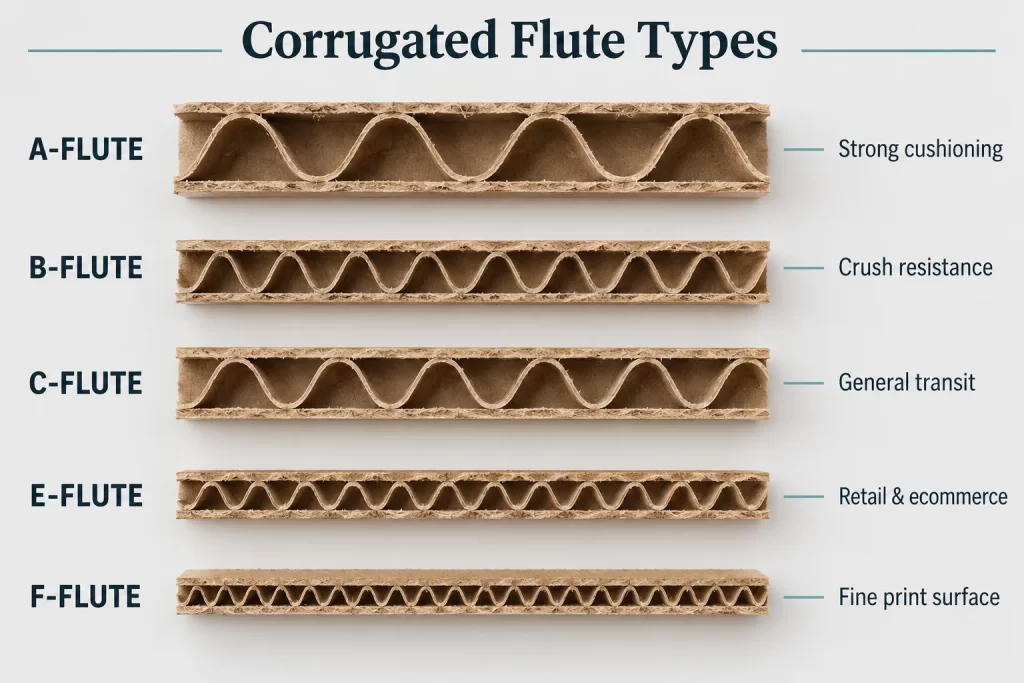
Double-wall boards combine profiles,
such as BC or EB, to balance thickness, cushioning and stacking performance.
The flute letter alone does not state the full strength of a corrugated box;
liner and medium papers, grammage, box design and manufacturing quality also
matter.
How Are Cardboard Thickness and Strength Measured?
Cardboard thickness and cardboard
strength are related, but they are not the same. A thicker board is not always
stronger than a thinner board made with higher-performing fibres and a better
construction.
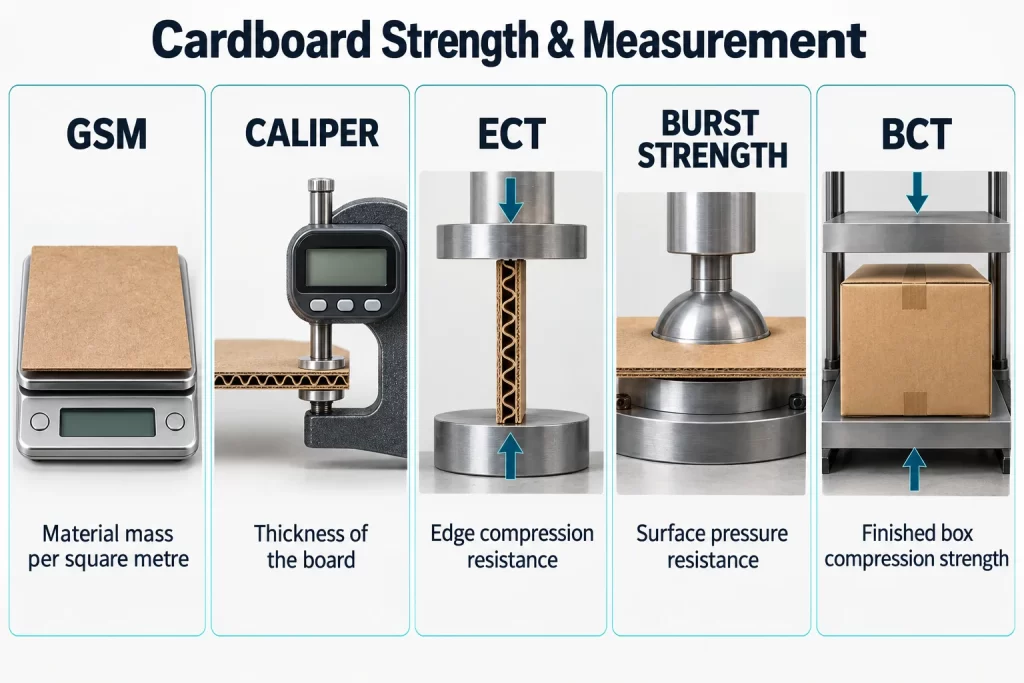
Key terms include:
- GSM: the mass of paper or board in grams per square metre;
- caliper: the measured thickness of a sheet or combined board;
- ECT: an edge crush test used to assess compression resistance at the board edge;
- burst strength: resistance to pressure applied through the board surface; and
- BCT: box compression strength measured on a finished corrugated case.
Ask the packaging supplier which
test or board grade supports the quoted load. “Heavy-duty cardboard” is a
description, not a measurable specification. A reliable assessment also
considers box perimeter, flute direction, storage time, humidity, stacking pattern
and whether the box will be palletised.
Is GSM Enough to Choose Cardboard Packaging?
GSM is not enough to select
cardboard packaging. It shows material mass per square metre, but it does not
fully describe stiffness, fibre quality, flute profile, moisture response or
the performance of a finished box.
For a folding carton, compare GSM
with caliper, stiffness, grain direction and the product load. For corrugated
packaging, request the combined board grade and a relevant strength measure.
For a rigid box, consider greyboard thickness together with box dimensions,
wrap and joint construction.
How Should a Business Choose the Right Cardboard Material?
Start with the packed product rather
than a preferred board name. A packaging supplier needs enough information to
match material, construction and cost.
- Record the product details. Confirm dimensions, packed weight, fragility, surface sensitivity and whether liquids, grease or sharp edges are involved.
- Map the journey. State whether the box is for a retail shelf, individual courier delivery, pallet distribution, export or a combination.
- Define presentation needs. Identify print coverage, colour accuracy, coatings, foils, windows and the desired unboxing experience.
- Check storage conditions. Humidity, cold storage, long stacking periods and changing temperatures can affect paper-based packaging.
- Review compliance needs. Food, cosmetics, pharmaceuticals and child-related products may require material declarations, migration controls or sector-specific checks.
- Test a sample. Approve structure and print separately, then carry out a packed-product test before a large run.
If the product is fragile, do not
rely on the outer board alone. Correctly designed inserts, partitions or
cushioning can reduce movement and improve protection without making every
panel unnecessarily heavy.
Which Cardboard Gives the Best Print Quality?
Coated paperboard usually provides
the most controlled surface for detailed retail graphics, small text and
accurate colour. E-flute corrugated board can also produce a clean printed
result, particularly with a suitable white liner or litho-laminated surface.
Natural kraft creates lower contrast and changes how some colours appear.
Print method matters as much as
board choice. Digital print can suit shorter runs and versioned artwork.
Lithographic print is often selected for detailed, high-quality graphics. Flexographic
print is widely used for corrugated transit packaging. Always proof important
brand colours on the intended substrate because an on-screen colour does not
predict the final printed result.
Is Cardboard Packaging Suitable for Food?
Cardboard can be used for food
packaging when the complete material system is suitable for the intended
contact and conditions. The board, recycled-fibre content, inks, adhesives,
coatings and barriers must be considered together. Direct contact with greasy,
wet, hot or frozen food may require a functional barrier or a separate
food-safe liner.
“Food-grade cardboard” should not be
accepted as a vague sales phrase. Tell the supplier what food is being packed,
whether contact is direct, the expected temperature, contact time and storage
conditions. Ask for the relevant declaration or supporting documentation for
the finished specification.
Is Cardboard Packaging Recyclable?
Many clean, fibre-based cardboard
packs can enter household or commercial paper recycling streams in the UK.
Recyclability can be reduced by food residue, wax, plastic film, heavy
lamination, certain barrier coatings, magnets, foam inserts or mixed-material
windows.
Use the fewest materials needed for
performance and make removable components easy to separate. Environmental
claims should describe the actual pack rather than cardboard in general. If
recycled content, certified fibre or kerbside recyclability is important,
request evidence for the exact material and confirm the guidance that applies
in the intended market.
What Are the Benefits and Limitations of Cardboard Packaging?
Cardboard packaging offers efficient
printing, low pack weight, broad structural choice and established recycling
routes. Folding cartons and many corrugated styles can also be supplied flat,
which reduces storage space before packing.
Cardboard has limits. Untreated
fibre absorbs moisture, thin cartons offer little cushioning, and oversized
boxes can fail even when the board sounds strong on paper. Foils, films,
windows, coatings and inserts may complicate recycling. Good packaging
therefore balances material, structure and supply-chain conditions instead of
treating cardboard as a universal solution.
What Common Cardboard Packaging Mistakes Increase Cost?
The most common mistake is
specifying board before confirming the product and distribution route. Other
avoidable problems include:
- selecting material by GSM alone;
- using an oversized box that leaves the product free to move;
- adding board thickness instead of improving the structure or insert;
- ignoring humidity, stacking time or courier handling;
- approving artwork without a structural sample;
- assuming every kraft or brown box is environmentally preferable; and
- placing a bulk order without testing a packed production sample.
A box can pass a visual inspection
and still fail in use. Test the weakest likely condition, not only the ideal
one.
Choosing Cardboard Packaging with Hi Custom Boxes
Hi Custom Boxes helps businesses
match cardboard material to the product, print requirement and route to market.
Custom options include folding cartons, corrugated mailers, shipping boxes and
rigid presentation packaging in made-to-measure sizes.
For a useful recommendation, provide
the product dimensions, packed weight, quantity, preferred box style, artwork
requirements and how the order will be stored and delivered. The team can then
advise on a suitable starting specification and sampling route.
Discuss your cardboard packaging requirements
Need packaging advice for your next order?
Share your box size, material, quantity, and artwork needs. Our team can guide you before production starts.